GW in the Community: Building Pipelines to Success for D.C. Youth

Promising Futures engages D.C. middle and high school students as ambassadors and peer educators with a focus on everything from health to leadership skills.

When she was still in high school, Maranda Ward, Ed.D. ’17, wished that there was an outlet for her to meet other like-minded teens interested in engaging with their community.

It wasn’t until she started attending Spelman College that she was able to feel the power of peer education firsthand and see exactly what she had been missing. Once she had the opportunity to develop a youth program of her own, she knew peer education had to be a big part because of the benefits for the audiences as well as the peer educators. The benefits can be especially powerful for youth with marginalized identities because of the group-identity developed through these programs.

“I knew that I wanted to be part of creating that type of community for youth because I feel called to lead and serve youth,” Dr. Ward said.

See full story:
GW Today.

Mayor Muriel Bowser Discusses D.C.’s Future

During a George Talks Business Event, the mayor shared plans she has to attract businesses to D.C. and solve some of the problems the District is facing with affordability.

For anyone interested in public service, being the mayor of your hometown is “the best job you can have,” Washington, D.C., Mayor Muriel Bowser said.

There is a rhythm to the job, she said, and in her second term leading the District, she has learned a great deal about having the courage to make tough decisions to the benefit of the people she serves.

“Being a local government official puts you in front of your constituents each and every day—and in your day-to-day life,” Ms. Bowser said. “Being able to understand their vision for how our city will go into the next generation is critical to winning their trust and keeping their trust.”

See full story:
GW Today

GW, D.C. Leadership Remember Mark Plotkin

Former mayors and prominent Washington, D.C., figures spoke about Mark Plotkin’s legacy in the District during a memorial service at GW.

The memorial service for journalist, political commentator and George Washington University alumnus Mark Plotkin, B.A. ’69, was planned out five years ago on a napkin.

Mr. Plotkin’s close friend, D.C. Councilmember Jack Evans (D), planned the service with Mr. Plotkin during a conversation at Morton’s Steakhouse in Georgetown where Mr. Evans asked Mr. Plotkin what he should do in the event of Mr. Plotkin’s death.

So, everything from the location (Mr. Plotkin wanted the memorial service to be at GW) to the songs played during Wednesday’s memorial service in Jack Morton Auditorium was requested by Mr. Plotkin himself. Mr. Evans described Mr. Plotkin as “a true friend but a real character.”

See full story:
GW Today.

Getting to Know the DMV: Adams Morgan

This vibrant and culturally diverse D.C. neighborhood offers a bit of everything for lovers of food, art and history; its popular Adams Morgan Day festival is Sept. 8.

Adams Morgan blends a rich, diverse history from a legacy of immigrants, activists and revolutionaries with artistic and culinary expression that makes this neighborhood a must-see.

Originally known as simply “18th and Columbia,” which refers to its major crossroads in Northwest D.C., activists and urban planners in the 1950s sought to create a new identity for the neighborhood with a name that unified Washington, D.C., residents across racial lines.

Black and white families were fighting together for better education for all, even at a time when area schools were still segregated. To show their unity, parents from the whites-only Adams School (named for President John Quincy Adams) and the “colored” Morgan School (named for city Commissioner Thomas Morgan) organized as the Adams Morgan Better Neighborhood Conference, giving the area a new name.

In the 1960s as D.C.’s population expanded, Adams Morgan attracted younger and more diverse residents to the then-affordable residences. Artists and musicians gathered in the smaller neighborhood buildings, and the Black Panthers and anti-Vietnam War activists took up space along the 18th Street corridor.

Today, international shops and restaurants line the streets of Adams Morgan, and residents throughout the District take advantage of everything the neighborhood has to offer.

See full story:
GW Today.

Experts Talk about Housing Segregation in D.C.

The digital history project “Mapping Segregation in Washington DC” sparked conversation on the lasting impact of decades of housing discrimination in the nation’s capital.

In the 50th year since the 1968 Fair Housing Act was passed, researchers launched a digital history project on Wednesday to unveil discriminatory patterns in housing that shaped Washington, D.C.

In collaboration the George Washington University’s Center for Washington Area Studies, “Mapping Segregation in Washington DC” serves as a resource to provide context for discussions of race and gentrification in D.C. It reveals a detailed look at the impact of racially restrictive housing deed covenants that prevented African Americans, and sometimes other groups, from living in certain parts of the city and therefore controlling where they could reside.

Project directors Sarah Shoenfield and Mara Cherkasky, with Prologue DC, said that several stories emerged through their thousands of hours of research into D.C. real estate records. Ms. Cherkasky, M.A. ’85, who earned a master’s in American studies from GW, said the data showed how many and where legal challenges to these restrictive covenants took place, and how private developers defined the city’s racial landscape through these covenants.

“One thing we learned about this is that if a picture tells a thousand words, a map can tell stories that no words can tell,” Ms. Cherkasky said.

See full story:
GW Today.

Racial Bias Shadows Bike Share Program

Baltimore residents gather for a “bike party.” (Bikemore)

Baltimore’s recently implemented Bike Share program boasts of being the largest electric-assist bicycle fleet in North America. But, as the city has seen with much of the biking infrastructure, Baltimore Bike Share has been met with criticism of its inequity.

A series of maps composed by blogger Ellen Worthing show bike rack locations, bike lanes and bike share stations concentrated in the city’s “White L,” the L-shaped area of Baltimore of primarily White neighborhoods such as Hampden, Federal Hill and Locust Point. Melody Hoffman, author of the book “Bike Lanes are White Lanes,” said that this has been the case in major cities all over the country.

“Baltimore just made a nonverbal statement that Bike Share is for tourists and downtown business people,” Hoffman said. “When they try to expand it, they’re going to have a really hard time getting other people on those bikes because it’s going to seem like it’s not for them because it wasn’t for them in the first place.”

The launch of Baltimore Bike Share is still relatively new with limited stations and 500 bikes, but this is similar to Bike Share launches in other cities. There are plans to have 50 stations by the end of this spring and continued growth after that. There is a call for the Bike Share to expand to lower income neighborhoods, and this Bike Shares, like New York’s similar Citibike program, is facing the same criticism.

Philadelphia’s Bike Share program Indego, Hoffman said, started from an equitable framework which is more effective than trying to “retrofit equity” as many Bike Shares across the country would have to do.

“Bike Share itself is maybe not designed for the needs of lower income people who don’t bike all the time,” Hoffman said. “And so, the discussion could also be, ‘is Bike Share really the answer to the transportation inequity issues in Baltimore?’”

See full story:

The Afro-American

Baltimore Residents Festive and Reverent at MLK Day Parade

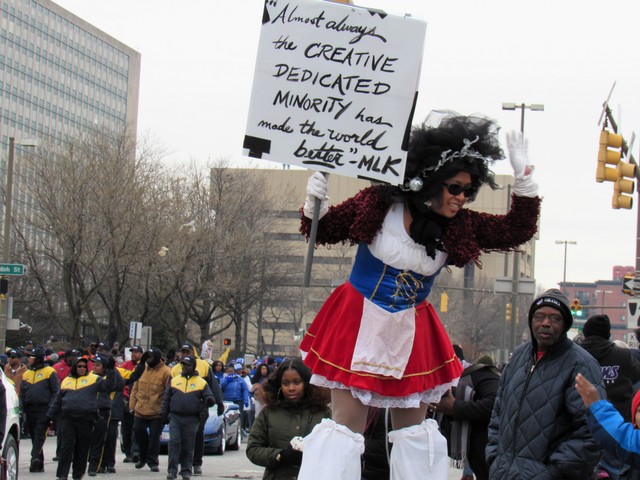
A woman on stilts waves to the crowd during the 17th annual Martin Luther King Jr. Day parade. (Photo by Briahnna Brown)

A woman on stilts waves to the crowd during the 17th annual Martin Luther King Jr. Day parade. (Photo by Briahnna Brown)

The people of Baltimore came out in droves to celebrate the life and legacy of Dr. Martin Luther King Jr. at the 17th annual Martin Luther King Jr. Day parade.

The procession marched down Martin Luther King Jr. Boulevard from Eutaw Street to Baltimore Street. Many in attendance said they were thankful that it was not as cold as it was during last year’s celebration.

The crowd cheered and waved for Mayor Catherine Pugh, who was at the front of the procession, and State’s Attorney Marilyn Mosby. The parade’s grand marshal this year was Baltimore native singer/songwriter Brave Williams, known for her appearances on “Making The Band” and “R&B Divas L.A.”

See full story:

The Afro-American

Tessa Hill-Aston Wins Highly Contested Baltimore NAACP Election

NAACP 5&6: Voter turnout was high on Tuesday night as NAACP members stood in line for hours to cast their vote for branch president. (AFRO/Photo by Briahnna Brown)

Voter turnout was high on Tuesday night as NAACP members stood in line for hours to cast their vote for branch president. (AFRO/Photo by Briahnna Brown)

Tessa Hill-Aston will retain her presidency of the Baltimore City Branch of the NAACP after being re-elected to a fourth term Tuesday night over newcomer Cortly “C.D.” Witherspoon.

“I will continue to do the things that I’m doing with the good group of people that I have working with me,” Hill-Aston said.

Hill-Aston also said she looks forward to continuing her work in the areas of economic development, private sector, housing, landlords, the courts, and bridging the gap for those leaving foster care.

See full story:

AFRO American

Family of Korryn Gaines Disappointed in Lack of Charges Against Officers

Rhanda Dormeus, mother of Korryn Gaines, stands with family attorney J. Wyndal Gordon, seen wearing a Colin Kaepernick jersey under his jacket, at a press conference Sept. 21. ( Photo by Briahnna Brown)

Rhanda Dormeus, mother of Korryn Gaines, stands with family attorney J. Wyndal Gordon, seen wearing a Colin Kaepernick jersey under his jacket, at a press conference Sept. 21. ( Photo by Briahnna Brown)

Lawyers for Korryn Gaines’ family confirmed that the Baltimore County State’s Attorney’s Office will not file charges against the officers involved in the death of 23-year-old Korryn Gaines.

Wyndal Gordon, along with the Gaines family and their attorneys, met with State’s Attorney Scott Shellenberger on Sept. 21 to discuss the case. He revealed that according to Shellenburger, Officer First Class Ruby shot Gaines from the hallway outside of her apartment, and did not fear for his own life, but for the life of his partner who “wasn’t even in the field of view of Korryn Gaines” when Ruby shot her.

See full story:

AFRO American

Finishing Fence of Slain Baltimore Father Becomes Cause

Community members and leaders helped to build the fence that Kendall Fenwick wanted around his house to give his children a safe space to play but was gunned down before he could do so. (Photos by Brelaun Douglas, HU News Service)

BALTIMORE — Concerned residents, friends, political figures and police officers came together to finish what a slain father had started.

Kendal Fenwick, 24, was gunned down outside his home on Park Heights Avenue in west Baltimore.  He was in the process of building a fence around his backyard to keep drugs and drug dealers away from his family home.

A truck driver, Fenwick wanted to give his three children a a safe haven in the midst of a city plagued by violence. For his actions, police said, he became the 295th homicide victim in a city where murders have now climbed past 300.

On a bright, crisp Sunday morning, dozens gathered to pitch in and help complete that dream. Attorney Ivan Bates, a friend of Fenwick’s father, helped launch the event through social media and a hashtag #FinishTheFence.

See full story:

HU News Service.

The Mississippi Link.